
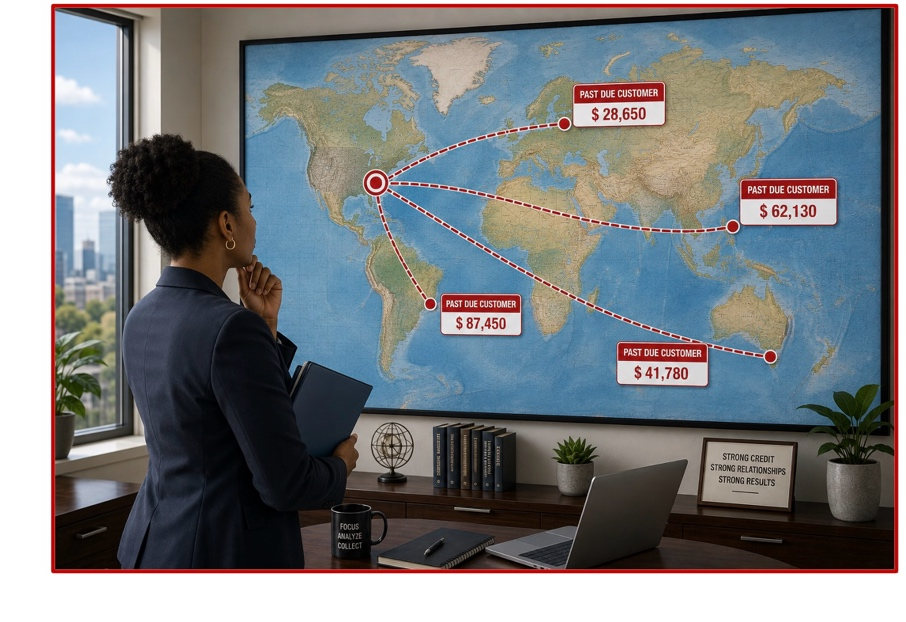
Selling internationally can open the door to tremendous business opportunities. But even when dealing with financially strong, long-term overseas customers, selling on credit can still be a risky business.
A customer may have an excellent payment history and strong financial condition today, but we never know what tomorrow may bring. Wars and geopolitical conflicts, such as the recent conflict involving the United States and Iran, can disrupt trade and supply chains almost overnight. Tariffs, sanctions, currency fluctuations, recessions, political instability, and other unexpected events can also put tremendous financial pressure on companies that previously appeared very solid.
In other words, today’s excellent international customer can sometimes become tomorrow’s collection problem through circumstances that neither the creditor nor the customer could have anticipated.
And when an overseas customer does stop paying, the distance that once seemed insignificant can suddenly feel enormous.
With a domestic customer, most credit managers understand the collection options available to them. They can call, email, place the account on credit hold, refer it to a collection agency, retain an attorney, and, when appropriate, consider litigation.
But what happens when the customer is 5,000 miles away?
This month we asked our readers what their companies typically do when an overseas customer won’t pay. The answers reflect something we see frequently: collecting internationally can seem so complicated that some creditors eventually conclude the account is simply uncollectible.
Before reaching that conclusion, here are a few things to consider.
Don’t Let Distance Delay the Collection Process
When an overseas invoice becomes seriously past due, it can be tempting to continue sending emails and making occasional telephone calls because the alternatives aren’t immediately obvious.
Unfortunately, repeatedly contacting a customer without escalating the collection effort can sometimes teach the customer that there are few consequences for not paying.
Whether a customer is 50 miles away or 5,000 miles away, the longer an account remains delinquent, the more difficult collection can become.
A Credit Hold Only Works When the Customer Needs You
Placing a delinquent international customer on credit hold can be very effective. If the customer needs another shipment or continued services, withholding additional credit may provide exactly the leverage needed to obtain payment.
But what if the customer doesn’t need anything else? A credit hold can prevent the balance from becoming larger, but it doesn’t necessarily collect the money already owed. At some point, another collection strategy may be necessary.
International Collection Resources Do Exist
Many companies don’t realize that international debt collection networks and associations can provide access to collection professionals in countries throughout the world.
A U.S. collection agency with international resources may be able to forward a claim to an established collection agency, law firm, or other qualified professional located in the debtor’s country.
That local resource will understand the language, business culture, collection practices, and legal environment in ways that would be difficult for a U.S. creditor to duplicate from thousands of miles away.
Local Presence Can Change the Conversation
Consider the difference from the debtor’s perspective. An overseas customer may receive numerous emails and telephone calls from a U.S. credit department and conclude that the creditor has limited ability to pursue the matter locally.
Then the debtor receives communication from a collection professional in its own country and its own language.
Suddenly, the creditor doesn’t seem quite so far away. That doesn’t guarantee payment, of course, but demonstrating that you have resources within the debtor’s country can change the dynamics of the collection process.
Know When the Economics Make Sense
Not every international receivable should be pursued indefinitely.
The amount owed, age of the debt, quality of the documentation, financial condition of the debtor, country involved, collection costs, and likelihood of recovery should all be considered.
Spending thousands of dollars pursuing a small account may make little economic sense. Walking away from a substantial receivable simply because the customer happens to be overseas may make even less sense.
Perhaps the most important international collection decision actually occurs before the first sale.
Before granting open-account terms to a foreign customer, ask yourself: If this customer doesn’t pay us, what are we going to do?
If the answer is unclear, consider whether the credit limit, payment terms, credit insurance, guarantees, deposits, letters of credit, or other forms of protection should be reconsidered before the goods are shipped or services are provided.
International collections can certainly be more complicated than domestic collections. Different languages, business customs, laws, time zones, and legal systems can all create additional challenges.
But difficult does not necessarily mean uncollectible.
An ocean may separate you from your customer. It doesn’t necessarily have to separate you from your money.
Your thoughts and comments (nseiverd@cmiweb.com) are most welcome!
Nancy Seiverd, President
CMI Credit Mediators, Inc.
All Rights Reserved
