
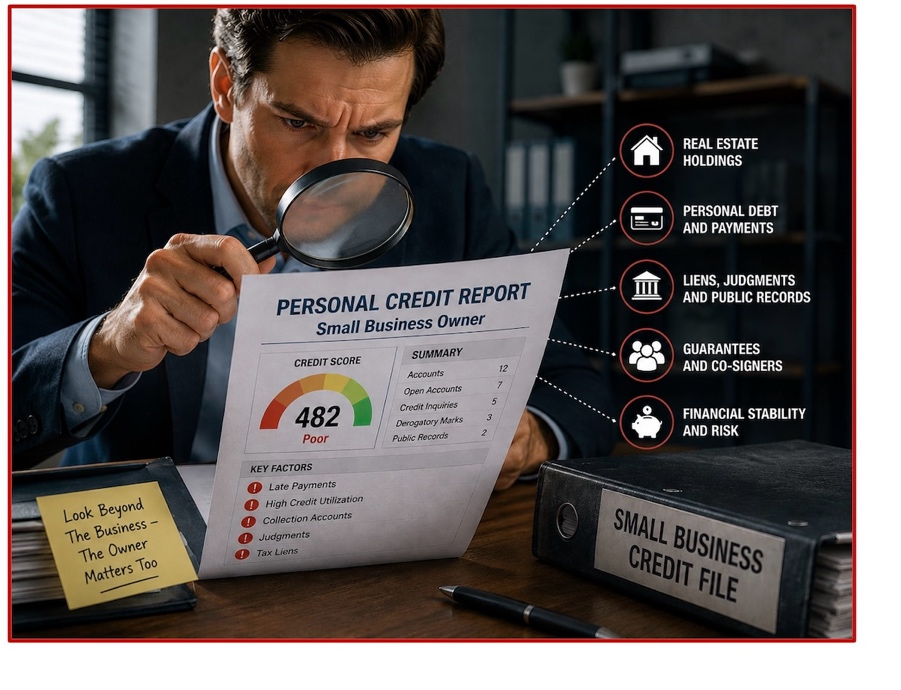
When evaluating a potential new customer, particularly a small enterprise, many suppliers automatically order a commercial credit report and assume they are receiving an accurate picture of the company’s financial condition. However, when dealing with a very small business, that assumption can sometimes be misleading. In many cases, the financial health of the company and the financial health of the owner are deeply interconnected, making a personal consumer credit report just as important, even more revealing than the commercial report itself.
Not long ago, an associate of mine received a call from a representative at Dun & Bradstreet informing him that one of their clients had requested additional financial information regarding his company’s annual sales and profits for the years 2023 through 2025. Although he asked who was making the inquiry, the representative explained that they were not permitted to disclose that information. Since he already had a strong suspicion regarding who the requester was, he provided approximate sales and profit figures over the phone. To be candid, he later admitted that he had probably inflated the numbers by roughly 30%. The representative then asked whether he would be willing to submit financial statements or tax returns to support the figures he had provided. For reasons of privacy and confidentiality, he politely declined.
The reality is that many commercial credit reporting agencies rely heavily on voluntarily provided information, estimated figures, supplier experiences, public filings, and payment histories. While these reports certainly have value, the information may not always be fully verified or completely current, particularly when dealing with smaller privately owned companies. In some situations, the supplier may unknowingly base a credit decision on information that is incomplete, outdated, or overly optimistic.
This is precisely why credit professionals should strongly consider obtaining a personal consumer credit report on the owner or principal of a very small business, especially when extending significant credit terms. In smaller companies, the owner’s personal finances and the company’s financial condition are often tightly linked. Financial stress in one area frequently spills over into the other.
Some of the most important insights a personal credit report may reveal include:
- Delinquencies on personal credit cards or bank loans
- Past due utility or telecommunications payments
- High personal debt utilization
- Collection accounts or charge-offs
- Personal tax liens or judgments
- A pattern of slow or irregular payment behavior
- Signs of financial distress that may not yet appear on commercial reports
- Excessive personal borrowing used to support business operations
Of course, personal credit reports must always be obtained legally and in compliance with applicable consumer protection laws and permissible purpose requirements. However, when properly utilized, they can provide valuable additional insight into the overall financial stability and payment habits of a small business owner. In today’s increasingly uncertain economic environment, relying solely on a commercial credit report may not always provide the full story. For credit managers, combining both commercial and consumer credit information can often lead to far more informed and safer credit decisions.
Your thoughts and comments (nseiverd@cmiweb.com) are most welcome!
Nancy Seiverd, President
CMI Credit Mediators, Inc.
All Rights Reserved
Image by freepik.com
