
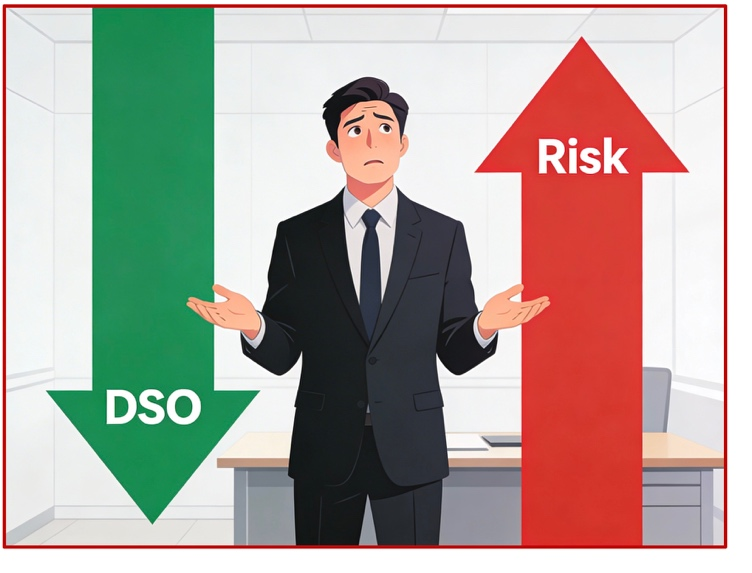
Reducing Days Sales Outstanding (DSO) is one of the most important goals to attain in credit management. When DSO drops, leadership notices. Cash flow improves. Reports look stronger. And bonuses sometimes even follow. On paper, a lower DSO signals discipline, efficiency, and operational success. But here’s the uncomfortable question every credit professional should ask: did you truly reduce risk, or did you simply accelerate collections without changing the underlying exposure?
DSO measures speed, not safety. It tells you how quickly invoices are converted into cash, but it does not measure the quality of the receivables themselves. A company can aggressively push collections, shorten payment cycles, and temporarily lower DSO, all while still extending credit to financially fragile customers. In some cases, tightening follow-up procedures improves metrics in the short term while deeper structural risks remain untouched. When economic conditions shift, those risks resurface quickly.
Consider what may be happening behind an improved DSO number. You might have:
- Pressured customers into partial payments to reduce aging
- Accepted short-term payment plans without reassessing credit limits
- Relied heavily on a small number of strong payers to offset weaker accounts
- Extended additional credit to maintain revenue growth
- Delayed placing marginal accounts on hold to avoid sales disruption
- Failed to update financial statements or trade references
Each of these actions can improve appearance without improving protection. DSO can decline even while concentration risk increases or credit exposure expands beyond safe thresholds.
Another factor often overlooked is portfolio mix. If sales growth shifts toward customers with historically strong payment habits, DSO may improve naturally. But if new customers are entering with limited credit history, or if existing customers are growing rapidly without updated risk analysis, the balance sheet may actually be becoming more vulnerable. Risk is not always visible in aging buckets. It often hides inside credit limits that have not been recalibrated or guarantees that have quietly expired.
Strong credit departments understand that speed and security are separate objectives. Ideally, they move together. But lowering DSO should be paired with questions such as: Are financial reviews current? Are personal guarantees enforceable? Are insurance policies active and adequate? Are disputes being resolved quickly to prevent masking deeper dissatisfaction? These questions move beyond performance metrics into risk management discipline.
The most effective credit leaders use DSO as a dashboard indicator, not a final verdict. They celebrate improvements, but they also ask what drove them. Was it stronger enforcement? Better documentation? Healthier customers? Or simply temporary pressure applied to a fragile portfolio? Sustainable cash flow comes from balanced risk decisions, not just faster collections.
Reducing DSO is an accomplishment. But reducing exposure, strengthening documentation, diversifying customer concentration, and enforcing disciplined credit limits, that is true risk management. In uncertain economic conditions, the difference becomes clear quickly. Speed improves liquidity. Structure preserves stability. And the strongest credit departments make sure they are achieving both.
Your thoughts and comments (nseiverd@cmiweb.com) are most welcome!
Nancy Seiverd, President
CMI Credit Mediators, Inc.
All Rights Reserved
Image by freepik.com
