
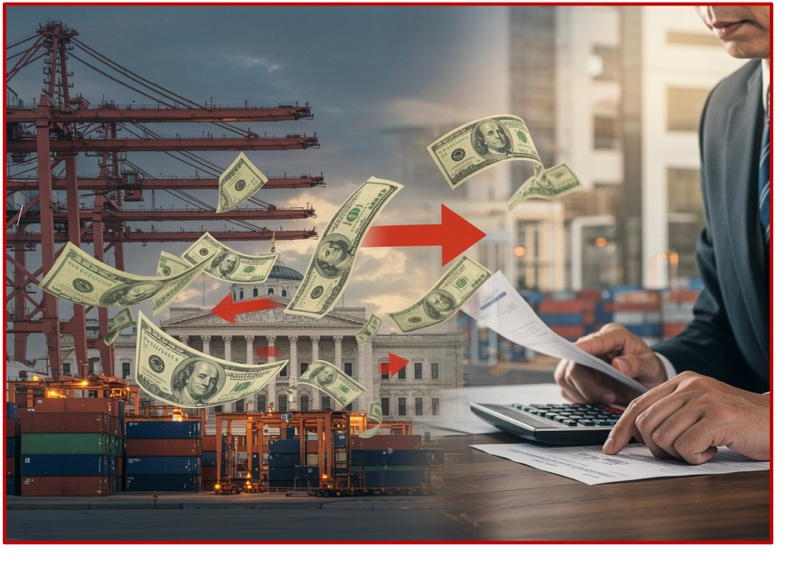
Due to the Supreme Court’s recent decision striking down Trump’s tariffs, refunds may be available to importers of record through U.S. Customs, but apparently only after litigation. In addition, because tariff costs were typically passed along through supply chains, downstream reimbursement will depend on various contract terms, making the economic unwinding of these costs complex and uneven.
At first glance, it may seem simple. If the government collected tariffs and later reverses or invalidates them, shouldn’t those funds be refunded? In theory, yes. In practice, the math and the mechanics are far more complex. Tariffs are paid by the “importer of record” at the time goods enter the United States. That payment is made to U.S. Customs and Border Protection, which operates under the authority of the U.S. Department of the Treasury. The legal framework governing tariff disputes falls under the jurisdiction of the U.S. Court of International Trade (CIT), a federal court specifically empowered to review challenges to customs decisions, duty assessments, and trade policy enforcement.
If a tariff is later ruled unlawful or repealed, the refund process typically begins with the importer of record. Much like overpaying federal income taxes, there is a paper trail. Import documentation, entry summaries, and duty payments are recorded electronically. If a court decision or legislative change authorizes refunds, importers can file protests or refund claims with Customs. In certain cases, litigation before the Court of International Trade has resulted in ordered refunds, sometimes including statutory interest. So from a documentation standpoint, the system is not unlike the IRS issuing a tax refund when a taxpayer overpays. The government knows who paid and how much.
However, this is where the “messy math” begins. While the importer of record writes the check to Customs, that importer often passes the cost downstream. A manufacturer increases its invoice price to a distributor. The distributor adjusts pricing to a retailer. The retailer ultimately adjusts prices to the consumer. By the time the tariff cost is embedded in the final selling price, it may have been absorbed, marked up, discounted, or partially offset through negotiation. If the importer receives a refund months or years later, the legal question becomes: is that importer obligated to reimburse its customers? In most cases, the answer depends entirely on the contractual language between the parties.
Some supply agreements include tariff adjustment clauses, allowing price modifications if duties rise or fall. Others are silent. Without explicit language requiring reimbursement, the importer may legally retain the refunded amount. From a legal standpoint, the government refunds the party that paid Customs. It does not attempt to unwind the entire commercial supply chain. The Court of International Trade’s role is to determine whether duties were lawfully assessed, not to redistribute downstream pricing adjustments among private parties.
Timing also complicates matters. Litigation in the Court of International Trade can take years. Appeals may proceed to the U.S. Court of Appeals for the Federal Circuit. During that time, companies have already accounted for the tariff expense in financial statements, tax filings, and pricing models. If a refund eventually arrives, it may be recorded as income in a later fiscal year. That creates accounting adjustments and potentially tax consequences of its own.
For credit and collection professionals, the implications are worth watching closely. If significant tariff refunds were issued, import-heavy customers could experience short-term liquidity improvements. However, expecting immediate downstream reimbursement may be unrealistic. Unless contractual provisions require pass-through refunds, businesses that absorbed tariff costs may never see direct repayment. Much like tax refunds, the system relies on documentation and formal claims, but unlike personal income taxes, there is no automatic redistribution beyond the original payer.
So, is it difficult to unwind tariff payments? Legally, the path exists. The documentation is clear. The Court of International Trade provides a structured avenue for challenges and recovery. But economically, the money may have already been dispersed throughout the supply chain in ways that cannot easily be reversed. At first glance, it appears messy. On paper, it is manageable. In reality, it sits somewhere in between, governed as much by contract language and timing as by trade policy itself.
Your thoughts and comments (nseiverd@cmiweb.com) are most welcome!
Nancy Seiverd, President
CMI Credit Mediators, Inc.
All Rights Reserved
Image by freepik.com
